From Marta . . . A Letter
Describing
Her Life in Hungary
1903 - 1924
Called
"Morning" by her grandchildren
Morning's
letter.......dated January 20, 1976
Translated from the
Hungarian
by
Dorothy
Padányi-Gulyás Bartlett
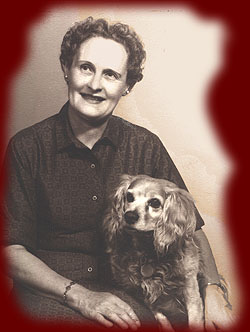
Morning
& Joker
Dear
Dorothy.......I am writing my memories as you asked me
to do. I am not
sure if it will interest
Susanne because they are not always funny or happy, but I am going to
write
them as I remember them.
My very first
memory, I must have been two years old [1905],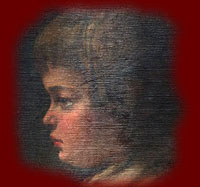 because I know that when I was
three,
we moved to the 11 Orlay street
house. So, at about
two years old, I
remember crying because I could not find a little doll that I loved. We were living in the Lonyai Street
house at the time, where I
was born, and my mother, Bumi, took my hand and we looked for my doll. First we looked in the living
room, where there were
beautiful palm trees, then
in the library, and finally in the kitchen and pantry, looking in the
drawers
where flour and sugar and other things were stored.
I am not sure whether we ever found my doll,
but I know that soon after that we moved to the Orlay street
villa. This villa
was built by Bumi's father, my
grandfather as a gift for us. My
mother,
Bumi (flower in German) wanted a house on Gellert Hegy (fort hill)
where there
was a yard.....Do you remember that a little?..... If I was three years
old, my
brother Miklos was 13 and my sister Mady was 9.
because I know that when I was
three,
we moved to the 11 Orlay street
house. So, at about
two years old, I
remember crying because I could not find a little doll that I loved. We were living in the Lonyai Street
house at the time, where I
was born, and my mother, Bumi, took my hand and we looked for my doll. First we looked in the living
room, where there were
beautiful palm trees, then
in the library, and finally in the kitchen and pantry, looking in the
drawers
where flour and sugar and other things were stored.
I am not sure whether we ever found my doll,
but I know that soon after that we moved to the Orlay street
villa. This villa
was built by Bumi's father, my
grandfather as a gift for us. My
mother,
Bumi (flower in German) wanted a house on Gellert Hegy (fort hill)
where there
was a yard.....Do you remember that a little?..... If I was three years
old, my
brother Miklos was 13 and my sister Mady was 9.
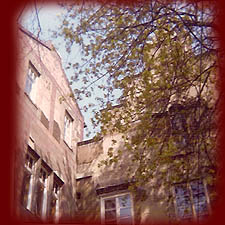 I
liked the Orlay
Street
house, because it was large then; where the
dining room was later, a large, wide staircase led to the upstairs
where the
bedrooms were. My brother Miklos played the piano beautifully. His room was next to mine,
and so every night
I went to sleep to him playing Beethoven or Wagner.
I will always be grateful to him for
this. Everything
was large. When we
had guests and I heard the bell,
there was a place upstairs where I could see who the servant was
letting in, by
laying on my stomach and peering down. In the spring, I got a long
haired goat
with a cart, and that was how I got around Gellert Hegy for years. In the summer we
were at Lake Balaton,
where we had a summer place. Lake
Balaton is the largest fresh water lake in Europe. I
liked the Orlay
Street
house, because it was large then; where the
dining room was later, a large, wide staircase led to the upstairs
where the
bedrooms were. My brother Miklos played the piano beautifully. His room was next to mine,
and so every night
I went to sleep to him playing Beethoven or Wagner.
I will always be grateful to him for
this. Everything
was large. When we
had guests and I heard the bell,
there was a place upstairs where I could see who the servant was
letting in, by
laying on my stomach and peering down. In the spring, I got a long
haired goat
with a cart, and that was how I got around Gellert Hegy for years. In the summer we
were at Lake Balaton,
where we had a summer place. Lake
Balaton is the largest fresh water lake in Europe.
My
father was
Secretary of State for Hungary
at that time. I
loved him, and I believe he loved me,
too. Each evening
he read to me while we
both sat in a large easy chair. He
still
did this, even after I learned to read, because it was nicer this way. He always read Hungarian
patriotic stories
from the time the Turks came into Hungary
and my grandfather Zrinyi
fought against them. My
father's salary
was 40,000 forint at the time, which was equivalent to $40,000 at the
same
time. But it was my
mother's father who
was the "well to do" one in the family.
At
Lake Balaton,
our place
was called Fonyod, and I had a lot of friends, boys and girls there. Our Villa
was on a hill, and when we wanted to go swimming in
the lake, there was
a nice, winding path that led down.
We
children were smart, and found a place where there was fine sand on the
hill,
where we could sit down and slide to the lake in seconds. When coming back up, we
used our two
donkeys with a pretty wagon and red
haltars on the donkeys to take us back up.
We
had a
beautiful life. In
the fall, before we went back to the Orlay Street
house, we spent two weeks
with our grandparents (Omama in my picture) in Domyan.
Domony was a 300 acre little estate,....but
it had everything: a
comfortable house,
good horses and a nice carriage with a special driver.
My Grandfather wanted to be a painter when
he was young, but his parents did not allow it.
Therefore, it was not until he was older that he
built a studio on the
top of the steer barn and painted there.
He was talented, but was not a trained painter. So, what he did was invite
poor, talented
painters to stay with him. He
watched
how they painted and learned. The
picture of Omama was painted by him....it hangs here in our dining room. We think that you look
much like Omama. She
was beatiful, too. I
am sure that Laszlo Fulop, who was Europe's
best painter of portaits at the time,
helped him to paint this picture.
In
Domony there
were 10 bedrooms,
so it was not just us who were there, but
also many cousins.
We played very well
together. There was
a large doll house for us in the
garden, but when I was there, I did not play with dolls, but live
bunnies,
chickens and puppies.....and any other critters I could get from the
village.
Hungary was 60%
Catholic, and the people in
Komony were Catholics. It
was the custom
that the church advertised and held an annual "bucsu", which meant
that whoever went to the Domony church mass on fair day
and prayed there would have all of their sins
forgiven. It was
really quite beautiful
as people came from other villages, on foot, the men and women in
separate
groups, carrying flags and singing on the way.
At the same time there was a fair in the village and
vendors came from
long distances and set up tents along the road.
You could buy all kinds of things: lace, boots,
dishes and cookies
called "mezeskalacs" made in all kinds of shapes: hussars (soldiers)
babies, very pretty, even flower garlands made of cookie! Do you remember the
cookies we used to make,
hussar, and hearts with a little mirror in the middle, and we hung them
on the
Christmas tree. My
grandmother, Omama,
gave me money to go to the fair to buy "mezeskalacs" cookies. I was happy to go, and
came home with two
white mice. As
things go, my two white
mice turned into twenty four white mice in two weeks.
We took them home to the Orlay Street
house; I made them a castle
out of a big box. I don't think I built it very well, because pretty
soon there
were white mice everywhere.
 I
would like to
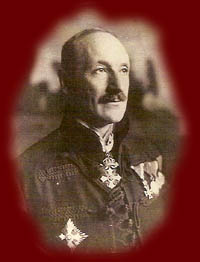
write some about my father's father, my
grandfather, and your great grandfather.
He was the president (chief justice) of the
Hungarian "Curia",
which is the highest court. He was the first official in Hungary
after
the king. At State functions, he sat at the right hand of the king. The Prime Minister came
after him in
priority. The
protrait of him, dressed
in "diszmagyar"
(formal
attire?) hangs in our dining room
(Kata
has that portrait now) His
portrait was
painted by Laszlo Fulop, Europe's
best known
portrait artist. The
broad red and white
sash I
would like to
write some about my father's father, my
grandfather, and your great grandfather.
He was the president (chief justice) of the
Hungarian "Curia",
which is the highest court. He was the first official in Hungary
after
the king. At State functions, he sat at the right hand of the king. The Prime Minister came
after him in
priority. The
protrait of him, dressed
in "diszmagyar"
(formal
attire?) hangs in our dining room
(Kata
has that portrait now) His
portrait was
painted by Laszlo Fulop, Europe's
best known
portrait artist. The
broad red and white
sash
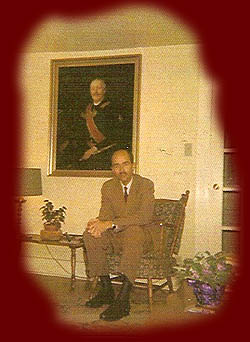
Ottó
von Habsburg beneath portrait of Morning's
Grandfather, Billings
across his
chest in the portrait means that he received one of the
highest
awards, The Large
Cross. (The order
of Lipot Large Cross). Later
he received the order of St. Istvan
(Steven) Large
Cross, also, which
carried with it the title of "baron".....he declined the title. I quote from his
autobiography: " I am
an old aristocrat....I don't want to be a new Baron".
There is a biography of my grandfather, in
which it is written that the king was very fond of him.
It just came into my memory that at the royal
dinners, at each plate there was a little golden basket with wrapped
candies in
it. On each candy
wrapper, there was a
picture of the king or
the queen. My
grandfather, and later my father brought these little baskets home to
us
children. We brats
used to say that the
candy was no good! We
visited these
grandparents a lot, and I remember that my grandfather sat in a big
chair, and
I was on his lap. When
we went
home, he gave each
of us a gold
coin. At that time
gold coins were still
in circulation.
I
was at Fonyod
at Belatelep,the part of Fonyod where our
villa and our friend's villa was, when a pilot named Bleriot, from
France, was
the first to fly across Lake
Balaton. That was a
big accomplishment
at the time. This same pilot was the first to fly across the English Channel.
I remember
Lindberg, though I never saw him, but read about him flying across the
ocean. I was at my
friend, Roesele's
house in Billings,
watching on TV when the first man walked on the moon. In
my long life, so many things occurred!
I
was at Fonyod
in Belatelep when we got the news, in
September of 1914, that the First World War had erupted. At that time,
the
"hussars" (soldiers) still
fought with swords on horseback, dressed in red
trousers with red caps.
One of
the first casualites of that conflict was was my great uncle Percel.
 My
father
studied to be a physician, although his family was
very much against it. He
never did
practice medicine, but
as Secretary of
State and Minister of Religion and Education, he established and built schools for the deaf
and mute, deaf
and blind, and
retarded. I don't
remember why, but I
remember that as an adult I toured several of the schools and saw my
father's
statue there. When
WWI broke out,
because my father had a medical degree,
he would go to the University (the same one where
Nagyapa got his
architectural degree later) which was being used as a treatment center
for the
wounded soldiers. He
helped treat the
wounded. We felt
that he was exposed
to (sharlacht ?)
and diphtheria, and
died after a three-day illness. He
was
54 years old. I was
11 years old, and
according to the European custom,
my
sister and mother and I wore black dresses for a year in mourning. My brother
Miklos was a soldier (so he wore
his uniform) and Bumi, my mother wore a long black veil. My sister Mady was being
courted by Balas
Jozsi, and during that year married
him. My
father
studied to be a physician, although his family was
very much against it. He
never did
practice medicine, but
as Secretary of
State and Minister of Religion and Education, he established and built schools for the deaf
and mute, deaf
and blind, and
retarded. I don't
remember why, but I
remember that as an adult I toured several of the schools and saw my
father's
statue there. When
WWI broke out,
because my father had a medical degree,
he would go to the University (the same one where
Nagyapa got his
architectural degree later) which was being used as a treatment center
for the
wounded soldiers. He
helped treat the
wounded. We felt
that he was exposed
to (sharlacht ?)
and diphtheria, and
died after a three-day illness. He
was
54 years old. I was
11 years old, and
according to the European custom,
my
sister and mother and I wore black dresses for a year in mourning. My brother
Miklos was a soldier (so he wore
his uniform) and Bumi, my mother wore a long black veil. My sister Mady was being
courted by Balas
Jozsi, and during that year married
him.
 It
was at that
time that Bumi
remodeled the Orlai street
house, and Mady and her husband lived upstairs and Bumi and I lived on
the main
floor. Everything
became very
different. It
was at that
time that Bumi
remodeled the Orlai street
house, and Mady and her husband lived upstairs and Bumi and I lived on
the main
floor. Everything
became very
different.
Kata
at Bumi's Entrance 1997
Meanwhile,
my
grandparents sold the estate at Domony; my
grandfather was getting old and did not want to have to deal with the
workers,
and for some reason the house would have to have been remodeled. I think it is
important for me to tell you
the following, because there has been criticism of how the old
aristocracy
worked their help very hard: when my grandfather sold the Domyon
property he
gave his long term workers the house they lived in, as a gift. I remember those houses
well...there was a
whole row of them, all white washed, with one or two rooms, depending
on how
many childrenwere in the family. We
went
back to visit them occasionally with my mother, Bumi, because, for
instance,
the daughter of the estate manager was Bumi's god child. So....my grandparents sold
Domony and bought
Besnyot, which was closer to Budapest. This is the place that I
loved so much. It
was only 60 acres, but the whole place was
beautifully landscaped and maintained with trees, flowers and roadways. The house was not
architecturally
attractive....it had a tower where my room was.
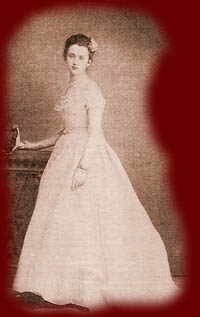 When
Bumi and I went out there in early spring,
there were so many birds
singing that it was really loud. There
were bushes under my window, which had been trimmed into a ball shape,
and a
meadow lark built her nest there.
I used
to watch very carefully for the baby birds to be hatched. And in the evening and
early morning the
adult birds sang beautifully. I
will
never forget that. When
Bumi and I went out there in early spring,
there were so many birds
singing that it was really loud. There
were bushes under my window, which had been trimmed into a ball shape,
and a
meadow lark built her nest there.
I used
to watch very carefully for the baby birds to be hatched. And in the evening and
early morning the
adult birds sang beautifully. I
will
never forget that.
Bumi
It
was so beautiful
there, no one could disturb us, and I felt as if the world were mine. On one side of the
property, our land
adjoined the king's forests. For
hundreds of years, the kings used this forest for hunting. At the time I was there,
there was no hunting
going on, but there was a great deal of wildlife.
We had permission to walk and to ride
horseback in the royal forest. It
was
mainly me who enjoyed that a lot.
Meanwhile,
the
elderly king (Joseph Ferenc) died, and Karoly
IV was crowned. My
family received an
invitation to the coronation, but Bumi, my mother, was still in
mourning for my
father and could not go anywhere.
Therefore my sister Mady and I went; Miklos, our
brother was still at
war. Initially he
fought as a
"hussar", then later they did not use horses any more and he was
trained to fly airplanes. The
coronation
was beautiful, everyone came in Hungarian
formal dress. The
king and queen,
and between them the three year old prince Otto who would be the next
king were
all dressed in snow white Hungarian formal dress.
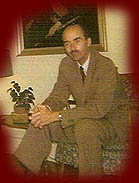  Prince
Otto had long, blond, wavy hair down
to his shoulders.....he was adorable.
Dorothy, do you remember, he came to Billings
and had dinner at our house. Time
had passed and he was no longer blond at
the time, he had a very high forehead and was most pleasant and
intelligent. So....back
so long
ago....the royal family came in a gold and glass carriage pulled by six
snow
white horses. After
the king and queen
were crowned in the Matyas Church,
the king mounted
his horse and rode up to a small hill which had Prince
Otto had long, blond, wavy hair down
to his shoulders.....he was adorable.
Dorothy, do you remember, he came to Billings
and had dinner at our house. Time
had passed and he was no longer blond at
the time, he had a very high forehead and was most pleasant and
intelligent. So....back
so long
ago....the royal family came in a gold and glass carriage pulled by six
snow
white horses. After
the king and queen
were crowned in the Matyas Church,
the king mounted
his horse and rode up to a small hill which had  been
built for this
occasion in
front of the church. The
king drew his
sword and sliced it through the air to the North, South, East and West,
which
meant that from whatever direction an enemy might approach, he would
protect Hungary. The poor man was not
successful in doing
this. The enemy
soon came from all
directions. This
ceremony that I have
described is hundreds of years old, and must seem very strange to you. But it was very beautiful. I believe that people enjoy this kind of
pomp and ceremony,
and I don't think that American parades can take the place of them. The Hungarian crown, at
least the lower
portion of it, was given to the first Hungarian King, Saint Istvan, by
the
Pope. In return, St Istvan converted the
Hungarian people ( who
were pagans) to Christianity.
The top
part of the crown came from "bizanc" (Bizantine?)
.
At a later date the two parts were welded together.
When we fled Hungary,
the crown was also brought out, and eventually came to the United States. The Communists want the
crown returned, and I
am often afraid that it may be given over to them. been
built for this
occasion in
front of the church. The
king drew his
sword and sliced it through the air to the North, South, East and West,
which
meant that from whatever direction an enemy might approach, he would
protect Hungary. The poor man was not
successful in doing
this. The enemy
soon came from all
directions. This
ceremony that I have
described is hundreds of years old, and must seem very strange to you. But it was very beautiful. I believe that people enjoy this kind of
pomp and ceremony,
and I don't think that American parades can take the place of them. The Hungarian crown, at
least the lower
portion of it, was given to the first Hungarian King, Saint Istvan, by
the
Pope. In return, St Istvan converted the
Hungarian people ( who
were pagans) to Christianity.
The top
part of the crown came from "bizanc" (Bizantine?)
.
At a later date the two parts were welded together.
When we fled Hungary,
the crown was also brought out, and eventually came to the United States. The Communists want the
crown returned, and I
am often afraid that it may be given over to them.
We
sold the
Belatelepi estate in Fonyod, because my sister
Mady's husband could not travel that far on the weekends. Now it was just me and my
mother, Bumi. Before
we sold Fonyod, I spent one more
summer there by myself, with an English
teacher by the name of
Miss
Aggie, a cook and a maid. Oh
the happy
olden times......situations like that could not be imagined now.
When
my father
passed away, each of us received 25,000
forint......the rest of his money was invested in [war bonds?]. We never got anything from
the war bonds,
since we lost the war. Sooo.....we
started to be less wealthy. I
was
home-schooled at Orlay street
with a governess during the school year, and in Besnyo from early
spring until
late fall.
In
Besnyo I did
not have anyone to play with, but I had my
little horse named Judka and a small dog.
I was totally content. I
must
have been about Susie's age at the time, about 13.
I took walks, rode horseback and took the
carriage into the woods, which in March were absolutely, totally full of violets.
I loved them and their scent.....in Hungary
they had a wonderful scent;
here they don't seem to have a fragrance.
When the lilacs bloomed, our estate was full of
lilacs. On the narrower
paths on the estate, the lilacs almost blocked the path, they were so
heavy
with blooms, they bent down and almost closed the way....I had to push
them
aside with my hands to get through.
This
even though the
paths and the bushes
were very well kept up.
Every day three
or four peasant girls, dressed in full skirts and bright scarves on
their
heads, did nothing but weed, rake and sweep the paths.
The fruit trees were beautiful in bloom.
too. Oh how I wish
you could have seen
it !
Once,
when I was
in my little carriage pulled by the horse in
the king's forest, I found six little bunnies.
The mother must have died and the poor little things
were helpless. I
took them home and raised them. When
they were grown and getting fat, the
cook started giving them strange looks and even my grandmother made
some
comment that scared me. The
next morning
I got up real early and took them back to the forest where I had found
them in
my little cart and set them free.
At
home, I left the cage door cracked and everyone thought they had
escaped from
there. I didn't say
a word.
Once
I
caught a peacock by hand. The
silly thing had gotten tangled in a wire
fence, and was not smart enough to back up to get free.
He was so beautiful.....I petted him for a
while and then let him go. In
the
evenings, about sundown, I would lay on my stomach under a bush and
wait,
sometimes for hours for
the deer to come
out in the clearing and graze. They
were
beautiful. While my
grandfather was
alive, we put salt blocks under the window of his studio (he had a
studio in
Besnyo) so the deer would come to the clearing and graze. When they came to lick the
salt, my grandfather
would draw pictures of them. I
was very
happy with my animals, but it may not have been so good, because I
became less
used to being around people. When
Bumi
wanted to take me to dance lessons, I cried and did not want to go. She would say, "that's the
Spanish in
you, and you have to fight it", when
I did not want to be around people.
But that was
later.
Meanwhile,
we lost the war which was a great
tragedy for the country and for us.
I
was young, so I did not understand the national implications, but I
began to
see that as the soldiers came home from the war, especially if they had
been
prisoners of the Russians, they came with communistic ideas. They were rough. In the front of our
Besenyi house there was a
life-sized statue of an stag. The
returning
soldiers used that as a target to shoot their pistols....they never hit
it, but
it made it dangerous for us to come out of the house.
In
Budapest,
the revolution began. The
king with
their six small children were at their country castle near us, and they
were
barely able to get out of the country.
There was Communism in Hungary
for half a year. There
was barely any
peace time. We were
fine in Besnyo,
because we had vegetables in the garden and fruit, but if we needed
meat or
salt or other things, they sent me to the nearby village, Godollo, to
buy
things. They sent me, bacause I would not let anyone else drive my
horse with
the carriage. She
was the only horse
left, and one cow....they took everything else.
Once when Bumi was not at home, I heard that they
were coming to take
our cow and my little horse.
I could
not have stood that. I
was very
scared. I got the
cow and my little
horse out of the barn and brought them up to the house.
No one saw me.
I brought them into the wash (laundry) room
and they stayed there for a week.
That
was how I saved them. Later
on, the
mood of the country improved some and I could use my horse and carriage.
Godollo
was a half hour
from our house by
horse and carriage. If
I walked, cut
across the forest and climbed two wire fences, that was also about a
half
hour. When
I took the carriage, at the
border of the village everyone had to stop for the communist soldiers
and show
them your passport....even for traveling such a short distance. I had a passport, I had
been given one, but I
was so insulted by this idiocy that I would drive my horse by very fast
- by
the time they looked for me I was gone.
Judka was a good little horse.
Once they caught me, and one of the soldiers told
me, "little lady,
if you drive by the border one more time, I am sorry, but I will shoot
you,
because those are my orders."
After that, I went to the village on foot, through
the forest.
After
a
while the Communists, who were hated by gentlefolk and peasants alike,
lost
power. Horthy
Miklos put together a "white"
(red was considered
communist) government and congress and marched into Budapest. They elected him governor. In the
summer he and his family lived at the beautiful Godollo castle, and I
watched
with an aching heart as he rode every morning with his guards and his
daughter. I
outgrew my little horse
Judka, and because of the financial strain after the war I did not get
another
horse. I was alone,
and as much as I
loved the other animals and the forest I began to feel lonely. Two days a week
I stayed in Budapest
with Bumi and took french lessons,
history of art, and finally I even took (ballroom) dancing lessons. It
was hard to become reaquainted with the
girls and boys with whom I had spent my childhood.
I was not interested in the things they
talked about and they were not interested in my animals and trees.
I
was sixteen when I met a
boy with whom I
had much in common. His
name was Toni
Lossonczy, and it turned out that his family also had a place in
Besnyo, but
quite a way from ours, so we never knew each other.
He came to our house a lot and he was a
talented painter and could draw well, which interested me. I learned a lot from him
about painting and
art appreciation. Tibor
Vamossy also
came to our house a lot and we became good 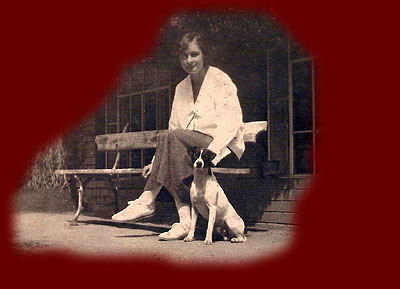 friends. But I was in love with
Tony, and he with me.
The war finally was over, the situation became better, but the
victorious
nations and their politicians were discussing how the New Europe should
be
arranged. friends. But I was in love with
Tony, and he with me.
The war finally was over, the situation became better, but the
victorious
nations and their politicians were discussing how the New Europe should
be
arranged.
Marta
& Gogo
I am
always amazed how
Americans, who hardly learn anything about European history in school,
should
decide the fate of nations and how the borders that have been in place
for a
thousand years should be changed.
In Hungary
there are families who have lived and worked and
been productive in the same place.
And then, somewhere, there is a conference
and the next morning these same people wake up to find that they are no
longer
a part of Hungary,
but maybe Romania
or Yugoslavia
or Austria. And then they lose their
ancient lands. The
young men, Tony and Tibor were studying at the Technical University. A long time ago they had
formed a club and
called it the Hungarian Christian Royalist Club.
Tony designed a very nice badge that they
wore.....I got one, too.
The club could
not do much, but along with the girls they organized some dancing
parties.
Once there 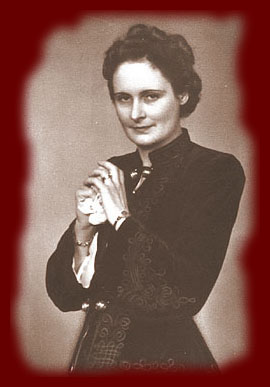 was
a garden party on Margit Island
that I went to. There
I was introduced
to Jeno Padanyi Gulyas. Tony and Jeno were inseparable friends. We were
all
together a lot during that winter in Budapest
and the next summer in Besnyo. I
was 18
years old, and the boys were 21, when the victorious nations gave
western Hungary
to Austria. A Hungarian military
officer by the name of
Pronay, a patriot, organized the western Hungarian insurrection. Many University and Technical University
students took up arms
and went to western
Hungary
to show
displeasure and to fight to prevent the change.
The Austrian papers called them "Bands of
Aristocrats". All
the boys that I knew went, and on the
third day, when Tony and Tibor where standing guard, they were shot
down. There is not
much I can say about this. I
do not understand politics. But
I do know that what these boys fought and
died for - a popular election –was granted by the Western
powers. The people
wanted to belong to Hungary,
and that is how they voted. That
is how Sopron and
the surrounding area remained part of Hungary. They did not hold popular
elections anywhere
else , and the powers took away Eldely, Felvideke, Delvideke without
asking the
people where they wanted to belong. was
a garden party on Margit Island
that I went to. There
I was introduced
to Jeno Padanyi Gulyas. Tony and Jeno were inseparable friends. We were
all
together a lot during that winter in Budapest
and the next summer in Besnyo. I
was 18
years old, and the boys were 21, when the victorious nations gave
western Hungary
to Austria. A Hungarian military
officer by the name of
Pronay, a patriot, organized the western Hungarian insurrection. Many University and Technical University
students took up arms
and went to western
Hungary
to show
displeasure and to fight to prevent the change.
The Austrian papers called them "Bands of
Aristocrats". All
the boys that I knew went, and on the
third day, when Tony and Tibor where standing guard, they were shot
down. There is not
much I can say about this. I
do not understand politics. But
I do know that what these boys fought and
died for - a popular election –was granted by the Western
powers. The people
wanted to belong to Hungary,
and that is how they voted. That
is how Sopron and
the surrounding area remained part of Hungary. They did not hold popular
elections anywhere
else , and the powers took away Eldely, Felvideke, Delvideke without
asking the
people where they wanted to belong.
My
mother, Bumi,
surrounded me with her love my whole life
and did everything for me. Her
main
concern was to ensure that I had everything I needed and to see me
happy. That is when
she bought me my horse,
Csipka, who was a
grey lipica mare that
I liked very much. I
again rode a great
deal in Besnyo, where we spent the greater part of the year. In the winter we brought
her in to Budapest
where she was boarded at the National Equestrian Center.

Time
passed, the
violets bloomed in the forests at
Besnyo. Many young
people came to our
house again, among them Jeno, your father, and we fell in love. We were engaged for a year
because he had to
finish school and then he spent the summer abroad for his education. We were married
in January of 1924, just 52
years ago.
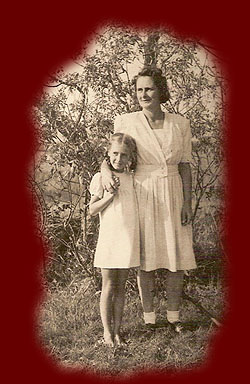
My
dear Dora, you asked that I write about my
childhood.
Then
I
grew up.
Love
and kisses, your
mother.
|